Wednesday, September 26, 2012

The Boy Who Changed the World

The Boy Who Changed the World
Written by Andy Andrews
Illustrated by Philip Hurst
Produced by Tommy Nelson 2010

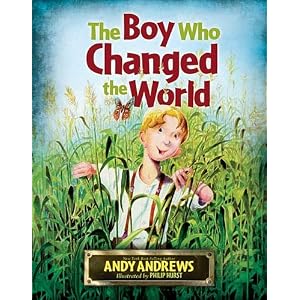
     The Boy Who Changed the World tells the story of four young boys who were all related in effecting one another down the road, but all making the change in the big picture of saving billions of lives. It's based on the principles of the butterfly effect, where small actions can lead to large changes along the way or way down the road.
     The perspectives on some the illustrations were really able to capture the size of the fields of corn that the boy stood in. There were a lot of yellow and red hues throughout the story that almost carried with it colors of change. I liked how with each illustration, you have a butterfly, and at the end it ties up the story about the butterfly effect.
     I liked how this story can encourage children to take charge and make change in their lives. There's the place in the front of the book where you can give this book as a dedication to someone, and I think that it would be a great gift to give to someone for a graduation or beginning a journey into a new profession. This story would be a great book to pull out on Earth Day and have time to talk about how little changes can lead to a big result.


The Graves Family

The Graves Family
Patricia Polacco
Published by the Penguin Young Readers Group 2003 
Fantasy
34 Pages

The Graves Family is a story about an odd family that moves in the neighborhood over night. They paint the house blood red, so other people in the neighborhood are hesitant to talk to them. Two friends, Seth and Sarah, come across the boy living at the house by the name of Hieronumus; they call him Ronnie and all three of them start to hang out together. Ronnie's dad is a scientist, and his mom is a chef; he has four sisters that he babysits. The family keeps a lot of wild and strange animals and plants in their house. The family has issues fitting in wherever they live. They start to have trouble with living in their new neighborhood, but you'll have to read to story to find out how they resolve fitting in.
     The art is very traditional for a Patricia Polacco book; it follows the same simple drawing of realism, but his time, her stories has more elements of details, such as people in windows and elements in the background that you have to pay special attention to.
     I thought that I'd like this book when I picked it up, but I found the ending highly predictable. I didn't think it was a bad story; it just wasn't for me. I think this particular story would have been better if the author has someone else do her illustrations for this particular book.


The Spider and the Fly

The Spider and the Fly
Based on the contemporary tale by Mary Howitt
Written and Illustrated by Tony Diterlizzi
Simon & Schuster Books For Young Readers, 2002
Fiction
40 Pages

     The Spider and the Fly is a winner of the Caldecott award. It's a story based on the contemporary tale by Mary Howitt. It tells the story of spider coercing a fly. This is a particular oddity because few tragedies are written for elementary age children. The art is dark and absolutely stunning. I love how reading it was kind of like watching a Tim Burton movie; it had that same feel. I loved how the characters expressions were so over dramatized. The Illustrator and gave the fly and the spider this kind of 1920s style that stood out in the clothing and the decor.
     I can see why this story won a Caldecott; the illustrations were superb and extremely detailed. My favorite part of the story is the letter from the spider in the end to the reader explaining why the story is a tragedy. He refers to Charlotte's Web and says that the spider should have eaten the pig. 


The Pigeon Finds a Hot Dog!

The Pigeon Finds a Hot Dog
Written and Illustrated by Mo Willems
Published by Hyperion Books for Children, 2004
32 Pages
Fiction

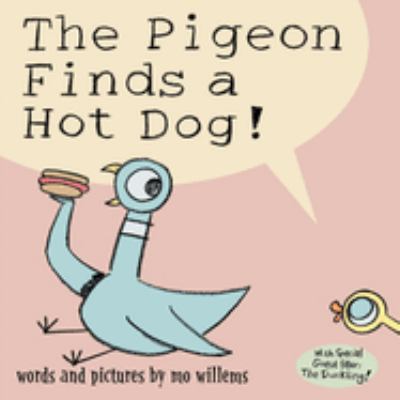
     The Pigeon Finds a Hot Dog is a hilarious book about a pigeon who finds a hot dog and a duckling who's never had a hot dog before. The Pigeon is very protective of his hot dog, but the duckling proposes a plan to solve the problem. 
     This story is written and illustrated by the same author and illustrator from the Caldecott winner for Don't Let the Pigeon Drive the Bus.The illustrations and colors are very young and playful. Mo Willems breaks the fourth wall through the writing and illustrations at points.
     This story would be great for a kindergarten or first grade classroom when giving a lesson on sharing. It could also be a great story for fourth grade concerning conflict and resolution. The coloration, thought bubbles, and use of fonts really makes this story stand out.
     I really liked the way this story stood out to me, and now I'd like to get a chance to read Don't Let the Pigeon Drive the Bus.


Mr. Lincoln's Way

Mr. Lincoln's Way
Written and Illustrated by Patricia Polacco
Published by Penguin Putnam, 2001
Fiction
35 Pages

     Mr. Lincoln's Way is another great story by Patricia Polacco about a elementary school principle by the name of Mr. Lincoln and his quest to help a boy named Eugene and his hate and intolerance towards other races. Mr. Lincoln is able to connect with Eugene over Eugene's love and knowledge of birds. The school terrarium is in need of birds and Eugene knows how to get more to come. Mr. Lincoln has a special way to make Eugene see that all the different kinds of birds are able to live together, and that Mr. Lincoln sees the students at the school as different and beautiful as Eugene sees the birds.
     Patricia Polacco has a very noticeable was of illustrating. Her illustrations focus on realism while giving details to facial expressions and perspectives.
     I really enjoyed this book. I think that Patricia Polacco has a special way of connecting with young readers and teachers. This book could be a great book to pull out if you're going over bullying or intolerance.
       

I Want My Hat Back

I Want My Hat Back
Written and Illustrated by Jon Klassen
Published by Candlewick, 2011
32 Pages
Fiction

     I Want My Hat Back is a hilarious book about a bear looking for his hat. The illustrations are what really makes the story. The way the illustrator paints the eyes and draws color to the text really sticks out to me. The bear is looking for his hat, but he can't find it. He goes from animal to animal, but nobody seems to know where it is.
     This story is appropriate for ages kindergarten and up. The illustrations are brilliantly done; the painted animals have such personality. You'll have to read it to find out if he finds his hat, but I'll tell you that there's a twist in the story that will make you crack up.


Wild About Books

Wild About Books
Written by Judy Sierra
Illustrated by Marc Brown
Published by Alfred A. Knopf, 2004
30 Pages

    
     Wild About Books is a book dedicated to Theodor Seuss Geisel. It tells the story of a librarian who drives her bookmobile by a zoo and finds that the animals at the zoo love to read too. The story makes references to such books and book series as Cat and the Hat, Harry Potter, Nancy Drew, The Wizard of OZ, Crictor and Goodnight Moon. The zoo animals love reading so much that they start to write their own books, and later they get their own library.
     The writing style is very whimsical with a rhyme scheme very similar to a Dr. Seuss book. The illustrations in the book are by vibrant and colorful; they tend to tell their own continuation of the story with each animal having their unspoken dialogues in the art.
     This book would be appropriate for grades kindergarten and up. I would suggest this book to be read on Dr. Seuss day to note how his literature has effected other writers. The story makes note that anyone and everyone can be a writer.
     I really enjoyed this story. It's a really fun story that can encourage young readers to find a new love in reading. I would encourage anyone who loves Dr. Seuss or Shel Silverstein to read this book.    


Bippity Bop Barbershop

Bippity Bop Barbershop
Written by Natasha Anastasia Tarpley
Illustrated by E. B. Lewis
Published by Little, Brown and Company, 2002
29 Pages
Fiction

     Bippity Bob Barbershop is a cute story about a boy's first hair cut. The boy is first awoken by a secret knock "Bibbity-be-bop-bop! Bippity-be-bop-bop"; it's his father who has come to take him to his first hair cut. The father and son dress up by matching each other. They go to a shop to get breakfast and the father tells the man at the store that it's the boy's first hair cut. Mr. J., the man at the store, gives the boy a double chocolate milk and proclaims, "this calls for a celebration...".
     The barbershop is a place for male bonding. When the boy is noticing the different types of hair cuts at the barbershop, this would be a good time to work on adjectives and correlating them to the illustrations. The boy becomes scared when it becomes his time for his hair cut, but his father sits next to him and tells him a trick about overcoming fear and being brave.
     The illustrations by E.B. Lewis are painted to look realistic and makes use of various perspectives. Every illustration makes it look like you're following this child through the experience of his first hair cut. An important illustration is the electric clippers that stands alone on a white page; this is later pertinent to story when it's the boy's turn for his hair cut, those very clippers are the ones that cause the boy to cover his head in fear.
     This story would be appropriate for students ages 4 and up. I could see this story mostly being appropriate in a kindergarten to first grade classroom. You could use this in a lesson focusing on overcoming fear and covering adjectives. 


Langston's Train Ride

Langston's Train Ride
Written by Robert Burleigh
Illustrated by Leonard Jenkins
Published by Orchard Books, 2004
29 Pages
Non-fiction

      Langston's Trade Ride really caught my eye on the book shelf with it's vibrant cover art. The story tells the tell of a train ride of the famous poet Langston Hughes in the 1920's to meet his father who had abandoned him when he was a child. The words have a rhythm to them that you pick up on as you read unique to a lot of children's literature. I loved the paintings on each page that depict the emotion and setting though color and the hodgepodge of images that weave together with the story. 
     As the story progresses, you get a glimpse into the thought process of the then 18 year old Langston Hughes as he writes his famous poem "I've Known Rivers". It appears to Langston as he travels along the river in his train seat that he is part of a greater history of people who are "deep like the rivers".
     This book would be appropriate for ages preschool and up. Since story could be used in a classroom during Black History month or could be a great book to read prior to a poetry lesson. I really enjoyed it, and I would highly suggest this story to anyone who enjoys poetry, history, and art.

Monday, September 10, 2012

The Mine-O-Saur

The Mine-O-Saur
Written by Sudipta Bardhan-Quallen
Illustrated by David Clark
Published by The Penguin Group, 2007
29 Pages
Fantasy

     On a personal level, I love anything that has dinosaurs in a story; however, on a professional level, this book is full of projects that could be used in the classroom involving subjects of rhyme schemes, the morality of sharing, extending the vocabulary of dinosaur names, and in the end, the value of friendship over possessions. The expressions on the dinosaurs' faces really cracked me up, and I had a lot of fun reading this book. 
     This story is appropriate for ages 4 and up, so this book would be great to pull out to facilitate differentiation. I could see a classroom really having fun taking turns reading this book verse by verse. By discussing what's going on with the characters, students could take time to group talk about experiences that they may have had that were similar to the Mine-O-Saur incident. This would be a great book to pull out if you were bridging from your reading & writing block into your science block involving dinosaurs.
     The illustrator took special note to detail facial expressions that really outlined the emotions of individual characters. The illustrations used jagged lines to demonstrate energy and excitement. The illustrations and story happens in the setting of a school, so everything besides the dinosaurs themselves are relatable to young readers.